The downside to worldwide celebrity.

The downside to worldwide celebrity.
America then, American now. How has the country and its people evolved from the early 1950s to 2012?
R.I.P. Dick Clark (1929-2012)
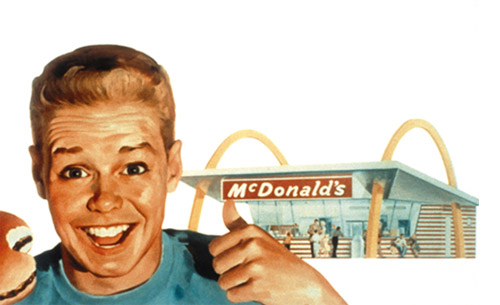
On the first day of my American Culture class I asked everyone to take out a piece of paper and either draw a picture of American culture or describe it in a word or two. I wanted the students to share the first thing that popped into their heads. Almost half the class said–you guessed it–the name of the most recognized fast food restaurant in the world.
McDonalds
The Golden Arches
Mickey D’s
Surprised?
McDonald’s is the world’s #1 fast-food company by sales, with more than 33,000 restaurants in 119 countries. Brothers Dick and Mac McDonald who ran a very efficient burger restaurant in San Bernardino, California had no idea that their single burger joint would go on to become a McDonald’s franchise empire under entrepreneur Ray Kroc.
Beyond Culture (1976) by Edward T. Hall
In 1976, Hall developed the iceberg analogy of culture. If the culture of a society were like an iceberg, Hall reasoned, than there are some aspects visible, above the water, but there is a larger portion hidden beneath the surface.
The external, or conscious, part of culture is what we can see above the water line. This tip of the iceberg includes behaviors and some beliefs.
The internal, or subconscious, part of culture is below the surface of a society and includes beliefs, values and thought patterns that underlie behavior.
Hall suggests that the only way to learn the internal culture of others is to actively participate in their culture.
When one first enters a new culture, only the most overt behaviors are apparent. As one spends more time in that new culture, the underlying beliefs, values, and thought patterns that dictate that behavior will be uncovered.
What this model teaches us is that we cannot judge a new culture based only on what we see when we first enter it. We must take the time to get to know individuals from that culture and interact with them. Only by doing so can we uncover the values and beliefs that underlie the behavior of that society.
(Source: http://www.constantforeigner.com © 2010)
Too much power is not good for a person or for a nation. It leads to hubris, to the childish illusion of omnipotence, and, even when driven by good intentions, to abuse. In the case of the United States, the illusion of being exceptional, the idea that the “Greatest Nation in the History of the World,” can do anything, is doubtless fed by the manner of the country’s inception. France and the United States are the only Western democracies born from revolution. Like France, the American republic likes to claim that it represents not only the hopes of humankind, but universal values. The American way is the global way, or it jolly well should be.
Imperial Hubris by Ian Buruma (Foreign Policy, November 2011, p. 65)
The 2012 American presidential race is between the incumbent Democrat, Barack Obama, and his Republican challenger, former Governor of Massachusetts, Mitt Romney. The concept of American exceptionalism is playing into this race as noted in this recent Reuters article (Romney defines hawkish yet murky foreign policy, 12 April 2012). This article suggests that U.S. foreign policy may figure important to the fall election, though it will never match the American public’s focus on the economy and jobs.
Beyond his success at devastating al-Qaeda with drone strikes and special forces raids – a trend begun under Republican George W. Bush but accelerated by the current administration – Romney’s team argues that Obama’s foreign policy achievements are limited.
By being content to “lead from behind” on issues such as the conflict in Libya, they say Obama has sacrificed America’s dominant global position. The attempted “reset” of relations with Russia has largely been a failure, they say, while planned military cuts could leave potential adversaries such as China and Iran with too great an ability to challenge Washington.
“Governor Romney believes in American exceptionalism, that we are great not just because of our military and economic power but also because of our values,” says Richard Williamson, a leading Republican foreign policy specialist and adviser to the Romney campaign who served in various roles under Ronald Reagan and both Bush administrations.
“The current president does not. … He believes in engagement – which has often not worked – while the governor believes we should say what we believe and work from a position of strength.”
 Tokyo Nancy Snow