The “Majority Minority” emerges in U.S. births

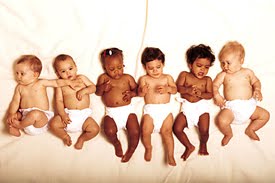
Whites Account for Under Half of Births in U.S.

US Census Bureau Press Release

The New York Times reports: A more diverse young population forms the basis of a generational divide with the country’s elderly, a group that is largely white and grew up in a world that was too. The contrast raises important policy questions. The United States has a spotty record educating minority youth; will older Americans balk at paying to educate a younger generation that looks less like themselves? And while the increasingly diverse young population is a potential engine of growth, will it become a burden if it is not properly educated?

What is emerging is a country where swaths of multicultural, diverse populations dominate.  In the state of Texas, 7 out of 10 of the children under the age of 1 are members of minority groups.  In contrast, babies born in the state of Utah are only 28% non-white.  Washington, D.C., the nation’s capital, and four states are majority minority.  They are California, Hawaii, New Mexico and Texas.

The Wall Street Journal reports: William H. Frey, a demographer at the Brookings Institution, says African-Americans are the largest minority among adults over 50. But for anyone younger—including the newborns forming America’s first ‘majority minority’ generation—Hispanics are the second-largest population group after whites of European descent.  “It’s a major turning point for American society,” he said. “We’re moving from a largely white and black population to one which is much more diverse and is a big contrast from what most baby boomers grew up with.”

What do you think the impact of this new Majority Minority will have on America’s view of itself?  We pride ourselves on diversity, but do you see any challenges or problems in the future? I’d like to know what you think.  
The Death of American Journalism Is Greatly Exaggerated

Good American journalism still exists.  You just have to work a little harder at finding the best examples.  I tend to view public broadcasting as superior to commercial broadcasting, which is why I’m sharing this example of good journalism from National Public Radio.  NPR has come under attack in the last decade or so.  Many conservative Republicans do not value having government-subsidized radio and television, but most Americans still value non-commercial broadcasting that relies on both foundation and individual contributions as well as some government funds.  The same critics of public broadcasting often think nothing of spending millions on propaganda broadcasting efforts like Al Hurra or Radio Sawa that have been used as information warfare tools in the War on Terror.

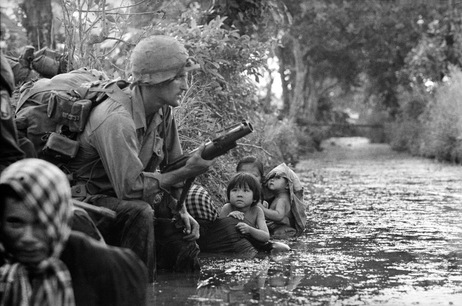
Have a listen to this NPR broadcast that features a radio interview with a German-born Associated Press war photographer, Horst Faas, whose pictures from the Vietnam War made him a household name.  Horst, 79, died on 10 May 2012.  Take a look at his photographs.  The Vietnam War is often referred to as America’s “living room war,” when many journalists covering the conflict sent home images broadcast on the evening news.  In the 1960s and 70s, the US did not yet have cable television so we relied on the Big Three television networks (ABC, CBS, NBC) for our news and entertainment.  Further, still photos in popular magazines like Life and Look dominated the public’s perception of the war in Vietnam.  These photos were quite graphic in comparison to the sanitizing effect that post-Vietnam media coverage has taken.

What do you think of the images that Faas took of the young men fighting in Vietnam?

Can you imagine how such images would shift public opinion on the war?  Even President Lyndon B. Johnson was so moved by how American journalists were covering Vietnam that he chose not to run for reelection in 1968.  He felt strongly that the media had swung public opinion away from the war, particularly a special report about Vietnam made by Walter Cronkite, anchor of the CBS News.

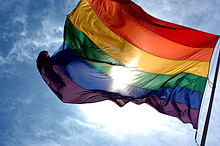
President Obama & Same-Sex Marriage in America

Obama supports same-sex marriage

This week was historic for LGBT rights.  President Obama became the first U.S. president to support same-sex marriage.  President Obama: “I have to tell you that over the course of several years, as I have talked to friends and family and neighbours, when I think about members of my own staff who are in incredibly committed monogamous relationships, same-sex relationships, who are raising kids together, when I think about those soldiers or airmen or marines or sailors who are out there fighting on my behalf and yet feel constrained, even now that Don’t Ask Don’t Tell is gone, because they are not able to commit themselves in a marriage, at a certain point I’ve just concluded that for me personally it is important for me to go ahead and affirm that I think same-sex couples should be able to get married.”

It was reported that Obama had to come out in support of gay marriage after Vice President Joe Biden said on NBC’s Meet the Press that he was “absolutely comfortable” with gay marriage.

Why are the Democratic incumbents in the executive branch of the US Government in support of a polarizing issue like gay marriage?  Could it have something to do with the enormous financial support Obama/Biden receive from wealthy gay and lesbian contributors?  Do you think their position is sincere or self-serving?  Let me know.

Read also: US churches split over same-sex marriage issue

Killing Bin Laden Ad

Watch this controversial 2012 ad that gives Obama credit for his commander-in-chief decisiveness about killing Osama bin Laden. Many critics, including myself, consider this ad from Obama’s “Truth Team” to be tacky and not befitting the office of president of the United States.

Surprise, I’m in Afghanistan! (Obama, that is)

President Barack Obama made a surprise trip to Afghanistan to announce a new strategic agreement with the government and to meet with the troops.  Read the transcript of his speech to the American people from Bagram Air Base.  Today there are 90,000 American troops stationed in Afghanistan, almost three times the number when Obama took office three years ago.  The American president pledges that the U.S. will hand over security to Afghan forces in 2014.  Is this a campaign stop or just the president doing his commander-in-chief duties?  Perhaps both.

And what is significant about the 2nd of May?

Obama: Comedian or Commander-in-Chief?

Watch a professional comedian Jimmy Kimmel do his comedy routine

Watch President Barack Obama do his comedy routine

On Saturday, 28 April, the annual White House Correspondents’ Association Dinner took place at the Washington Hilton.  The charity event, which raises money to support journalism scholarships, includes a popular American comedian as well as the American president engaging in a stand-up routine.  This year’s comedian was Jimmy Kimmel, host of ABC’s “Jimmy Kimmel Live,” included several digs at the state of American journalism.  Here are a few:

What’s black and white and red (read) all over? Nothing anymore.  (The answer used to be “a newspaper.”)

Some people say journalism is in decline, they say you’ve become too politicized, too focused on sensationalism, they say you no longer honor your duty to inform America but instead actively divide us so that your corporate overlord can rake in the profits.  I don’t have a joke for this, it’s just what some people say.

Kimmel was expected to poke fun at the American president, Barack Obama, and here are a few of his jokes.

Mr. President, I know you won’t be able to laugh at any of my jokes about the Secret Service so cover your ears if that is physically possible.

If you told me when I was a kid I would be standing on a dais with President Barack Obama, I would have said, ‘The president’s name is Barack Obama?’

Mr. President, remember when the country rallied around you in hopes of a better tomorrow.  That was hilarious.

You know the real reason people think you are from Kenya has nothing to do with your birth certificate.  It is the fact that you lost so much weight everyone thought you were the Kenyan that won the Boston Marathon.

He also went after the Republicans in attendance and the elites in the room.

I have my own theory about Lincoln’s death.  I think John Wilkes Booth was innocent, and I don’t even think it was an assassination.  I think Lincoln had a vision of what the Republican Party would become in 100 years, and he shot himself.

What a collection of people.  Here in one room we have members of the media, politicians, corporate executives, advertisers, lobbyists, and celebrities.  Everything that is wrong with America is here in this room tonight.

Obama got in some good one-liners too:

Four years ago, I was locked in a brutal primary battle with Hillary Clinton. Four years later she won’t stop drunk-texting me from Cartegana.

Obama on Romney: We both have degrees from Harvard. I have one, he has two. What a snob.

Last year at this time, this very weekend, we finally delivered justice to one of the world’s most notorious individuals. (Displays Photo of Donald Trump)

What is the difference between a hockey mom and a pitbull? A pitbull is delicious.


The Washington-Hollywood Nexus

White House Correspondents’ Weekend

“Yes, the White House Correspondents’ Association dinner is decadent and depraved. It is elitist and shallow, smug and insidery, a three-day orgy of corporate preening and celebrity suck-up so far removed from its earnest D.C. journalism roots as to be completely meaningless.  But you can’t fight it. You can’t change it. So, relax. Surrender. Just try to make the best of it, okay?”

This is the Super Bowl of politics, where Hollywood takes over Washington.  It’s a brief triumph over the joke that Washington is Hollywood for ugly people.  I know a lot about this connection between Hollywood and Washington.  I lived in Washington, D.C. for nine years (1986-1995) and have lived in the vicinity of Hollywood (Thirty Mile Zone or “TMZ”) since 2000.  If Washington is Hollywood for ugly people, then one might observe that Hollywood is Washington for dumb people.  That’s a very coarse observation, but the premium in Hollywood is sex appeal and physical appearance, while the premium in Washington is smarts and advanced degrees.  Hollywood types like George Clooney are able to cover both bases; he has sex appeal but also is well versed on human rights abuses in Africa.  There are still many Americans who disdain both Hollywood and Washington, Hollywood for its decadence and Washington for its overspending.


America’s Debt to Propaganda


There is some virtue in recalling the debt of America to propaganda. Far from being a recent affliction, propaganda has been one of the most powerful contributors to the growth of civilization on the North American continent. The propagandist of religion walked beside or a little in advance of the explorer, trader, and occupier of the broad acres of the New World. The natural reluctance of men to pull up stakes and settle overseas was partially overcome by the incessant use of propaganda.

It is true, as we are often reminded by disillusioned observers of the American scene, that the early bearers of European culture to this continent were often recruited from the debtor’s prisons of the Old World, and dispatched to the New World under constraint. Gradually, however, the lure of the West caught the imagination of Europe and sturdy citizens trooped by the millions to these shores. The alluring slogan, “the land of opportunity” is in itself a tribute to the tireless propaganda of the colonizing and shipping interests on both sides of the Atlantic Ocean. Without the seminal touch of capital investment, the abundant resources of the New World would have remained unused. The task of attracting capital to a fallow continent was undertaken by promoters who made use of every device in the propaganda repertory of their day. All in all, there is no doubt of the efficacy of propaganda in overcoming the hesitation of men to move themselves and to risk their capital in America. This, perhaps, is America’s greatest debt to propaganda.

Harold Lasswell

Reo M. Christenson, and Robert O. McWilliams, Voice of the People: Readings in Public Opinion and Propaganda (New York: McGraw-Hill, 1962), 323.

The 1960s: From Cool to Chaotic

1960s America has been described as a decade for the youth and as a turbulent turn in American political culture.  Like a reverse spring, it came in like a lamb and left like a lion.  John F. Kennedy defines the early decade.  He evokes cool at 43 years young when he is elected president in November 1960 with his younger and very pretty bilingual wife, Jacquelyn Kennedy.  Their two children, Carolyn and John, are picture perfect.  Kennedy proclaims “Ich bin ein Berliner,” initiates the idealistic Peace Corps, staves off nuclear disaster with Cuba, and holds very popular news conferences with a fawning White House press corps that looks the other way from his private life.   In November 1963 the dreams for the American decade die with the assassinated president.  LBJ takes office and is challenged by JFK’s younger brother, Bobby Kennedy, who is also assassinated in June 1968 after winning the California Democratic Primary, two months after Martin Luther King, Jr.’s assassination in Memphis, Tennessee.  In the summer of 1969 America is heavily involved in Vietnam but manages to fulfill a JFK dream to put a man safely on the moon. There’s so much turmoil by the end of this decade that one song helps people to forget their troubles.  It’s the top rated song of the year:  Sugar, Sugar by The Archies

Frontline

Frontline

The Fronline series is one of my favorite TV programs to watch in the United States.  Many of these investigative documentary films are available for online viewing.  You should watch an episode or two to get a feel for what matters in politics and culture.